- Rice mentioned in transfer reports, Arsenal criticised, and toxic politics in football.
- PSG owners hit by Iran attack: how will that affect PSG?
By Tony Attwood
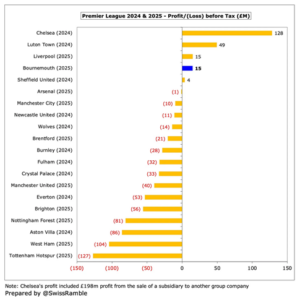
The data used in this report comes with the very kind permission from the regular email service from Swiss Ramble. And what their data shows is that only five teams in the Premier League actually made a profit last year: Chelsea, Luton Town, Liverpool, Bournemouth and Sheffield United. Their profits ranged from £4m for Sheffield United to £128m for Chelsea.
Now I want to be clear that, as always, while the data (which can’t really be argued with) comes from other sources, the commentary on events (which is, of course, an interpretation) is mine. And my interpretation of things as they stand is that, quite simply, we can’t go on like this.
And I say that because the majority of clubs are making losses, and although some of those losses are declining (Arsenal for example, made a loss of just £1m in the last reported accounts, which in footballing terms is about the cost of a player’s kneecap), some of them are out of control. The worst performing club, for example, were our old neighbours, Tottenham Hots, who managed to make a loss of £127m. In one season.
Now that sort of loss really is pretty horrific, and is going to be even more horrific if the club is working on the rather unscientific concept of (to quote Bob Dylan) “there must be some kind of way out of here.”
And I write that not because I have analysed every club’s accounts but rather because these clubs are run by people seemingly with years and years of experience of big business, and yet in many cases they are making a complete balls-up (to use the technical term) of running a self-sustaining business.
The simple question is, how do clubs that are making a loss, move into making a profit? For if we don’t know that, how does the financial decline ever end?
For there is also the realisation that profits, when they are made, tend to come from either selling a whole bunch of players in a rush, or selling on one player who may have come into the youth team at no transfer cost, and who has matured into a world-famous talent.
The data that is used to analyse club finances is collected by Swiss Ramble, whose publisher has most kindly allowed me to quote that data here. And the main table is of course, the profit and losses of clubs, which shows five clubs making a profit, Arsenal making the smallest of the losses and the 14 other clubs each making a loss, the most excessive of which are West Ham and Tottenham. Indeed, the four biggest losers (that is to say, one fifth of the Premier League) lost £400,000,000 between them. Which seems to go beyond the bounds of both investing for the future and being a trifle careless.
This data, and in fact most of the financial data here, comes from the football finance expert, Swiss Ramble, who analyses clubs across Europe in his Substack (and to whom I am most grateful for permission to use his figures.)
And very kindly, the publisher of the site has also alerted me to the fact that exactly half of the 92 clubs have published accounts for 2024/25 to date and only four of them have generated a profit. The average losses for Premier League clubs is £25.2m. What is more alarming is that most clubs that work incredibly hard to climb up the divisions must do so in the knowledge that they are climbing toward a loss-making activity.
Now, as I have often pointed out, I am not a financial wizard myself, but earned my living as a writer and as the chairman of a plc in England (which means I employed accounts within the company, and then a second set of independent accountants to check the work of the company accountants and keep Revenue and Customs off my back). So I know bits and pieces of how accounts work, but I would never be called a financial wizard.
But when I read that around three quarters of all the clubs in the Premier League are making a loss year after year, I think “this can’t go on”. The only thing that is keeping clubs at the submarine level (let alone afloat) is player sales.
Now the normal response to a situation like this is to say, “Ah yes, but it’s just like this at the moment; things will get better soon.” And if you think that, just wait until you see the next round of results. For we all know that clubs can make a loss as they start up and invest in the future, but what we have in football is clubs that have been investing and making a loss in maybe four years out of five, still following that pattern.
So it is very reasonable to ask the question: what happens next?
And my answer is that very few PL clubs have an operational model that has a positive financial outcome. Manchester City found one by being given fortunes and not following the league’s rules, but the rest of the league hated it, and they are not going to be able to get away with it much longer. Arsenal on the other hand, with its seemingly ceaseless production line of brilliant new young talent combined with an excellent worldwide promotion of the club, are getting close to financial balance.
Liverpool managed to get international support following years of excellent performances in Europe and domestic competitions. And Chelsea might claim they have their own model of buying up vast numbers of youngsters and being able to sell the best ones on. Although I am rather dubious about that, given the way they had to sell their women’s club to another company, their directors already owned.
Newcastle are struggling despite having a proven manager because they have been caught by the regulations and dare not breach them. ManU reported a loss of £113.2m for 2023-24 following losses of £28.7m in 2022-23, £115.5m in 2021-22, and their latest figures take total losses over the past five years to over £370m according to figures from the BBC
I won’t bother you by going through the fate of each club, but the fact is that Bob Dylan’s phrase “There has to be some way out of here” was actually said by the Joker to the thief. The answer – the only answer it seems – is to employ a brilliant manager, and invest in a youth system that produces players like Max Dowman, Ethan Nwaneri, Myles Lewis-Skelly, Marli Salmon, Brando Bailey-Joseph, Max Salmon, Jack Porter, Josh Nichols, Mikael Bonaveture Yetna, Ife Ibrahim….
Not only do they either play for Arsenal or get sold on, the publicity that the young players who come through the Arsenal youth system get means that every year Arsenal find they have more and more young players wanting to be considered by Arsenal, saving the club more and more on recruitment fees. Other clubs could use this approach – although it does take many years to set up. Quite probably we need to be thanking Arsene Wenger.

I immediately assumed that Chelsea had made their profit by selling something to themselves! I can’t wait to see what happens when they can’t offload all those people they now have on nine year contracts lol.
As a slight aside, I know Bob Dylan wrote the song but, personally, I can never read those words without hearing Hendrix singing them!
David Dein summed up Arsene Wenger :-
miracle worker.
Looks to me that your concluding sentence put it succinctly.
Well Mikey , that’s you n me both . Bob always acknowledged Jimi’s version was better than his original