
There is a particular kind of Saturday that every Arsenal supporter knows. Arsenal have played early, won, and for the next two or three hours the afternoon belongs not to what Arsenal did but to what everyone else does next. The title race, the top four, the mood of the week ahead – all of it is decided on other pitches, by other teams, while we wait. And yet the match reports the following morning will talk only about Arsenal, as though the ninety minutes just gone had existed in perfect isolation.
This is one of the quiet distortions of modern football coverage. A league table is a running total, not a snapshot, and Arsenal’s place in it is shaped as much by Liverpool dropping points at Brentford or Manchester City being held at home as by anything the Arsenal back four does on the day. But the narrative machine prefers single stories with single heroes and single villains, and so the context – the thing that actually determines where Arsenal sit on a Sunday night – gets flattened into a footnote beneath a headline that was half-written before kick-off.
Anyone who has read this site for any length of time knows the argument. The numbers almost always tell a richer story than the headlines, and the headlines almost always reach for the simplest version available. Home advantage, refereeing patterns, the clustering of difficult fixtures – these are measurable things, and when you actually measure them, Arsenal’s season tends to look rather different from the version served up between the adverts on a Saturday evening.
Think back to the seasons that turned on other people’s matches. Supporters of a certain vintage can still recall exactly where they were not when Arsenal scored, but when a rival dropped the points that mattered – a lead surrendered in stoppage time somewhere else entirely, a result that quietly rearranged the whole top of the table while north London held its breath. Those afternoons were never really about a single game. They were about the standings as a living, moving thing, reshaped minute by minute across the country.
Which is partly why the way supporters follow football has changed. It is no longer enough to watch Arsenal and read about the rest the next morning. More of us now keep a live football scoreboard open through the afternoon, following every relevant result as it happens, because we have learned that an Arsenal week is written across ten matches, not one. The goal that reshapes the title race might be scored two hundred miles from north London, and we would rather see it land in real time than discover it later in a montage set to dramatic music.
There is something faintly subversive about this, in the Untold tradition. The broadcasters would prefer you to experience football as a sequence of self-contained dramas, each with its own tidy conclusion handed to you at full time. Watching the whole board at once quietly breaks that spell. You begin to notice the patterns: which sides collapse the moment they leave home, which results the pundits were absolutely certain about and still got wrong, and how often the “inevitable” simply refuses to happen.
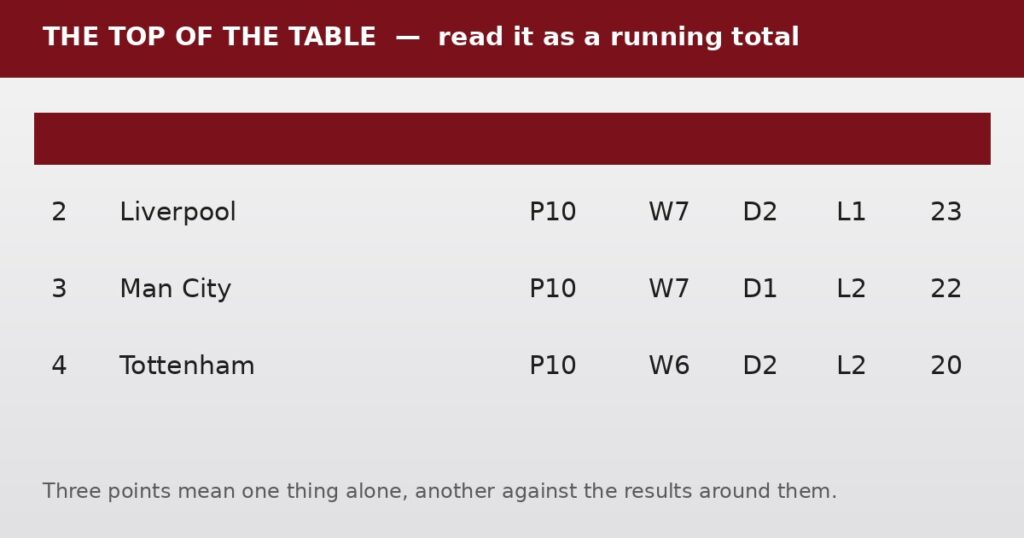
Take the top of the table on any given weekend. Arsenal’s three points look like one thing if you read them on their own, and quite another if you read them against the two teams immediately above and below who both dropped points the same afternoon. The gap that Monday’s paper calls “mounting pressure on Arsenal” was, in real time, a gap that narrowed. The supporter watching every result knew that by five o’clock. The reader waiting for the back pages found out two days later, carefully framed to fit whatever story had already been chosen.
It is the same instinct that has always driven this site’s interest in refereeing and home advantage. Once you accept that the table is a running total assembled from every pitch at once, you start asking why the totals fall the way they do – why certain sides seem to enjoy a following wind at home, why certain decisions cluster the way they do, and why the official version of a weekend so rarely matches the one you actually watched unfold live. Those questions tend only to occur to the people who were watching everything, rather than the people waiting for the highlights.
None of this is to pretend that results are everything, or that data settles every argument on its own – this site has always insisted on the opposite, that numbers are a starting point for thought rather than a substitute for it. But you cannot think clearly about Arsenal’s season without the full set of results in front of you, and increasingly that means watching them arrive live rather than accepting a tidy, curated summary after the fact.
So the next time Arsenal play early and win, resist the urge to switch the afternoon off. Keep it running. Watch the teams around you stumble or hold firm, watch the table rearrange itself goal by goal, and form your own view before anyone on a Monday morning forms it for you. The Arsenal story has never been only about Arsenal – it never could be – and the supporters who understand that have simply stopped waiting to be told how their own season is going.
